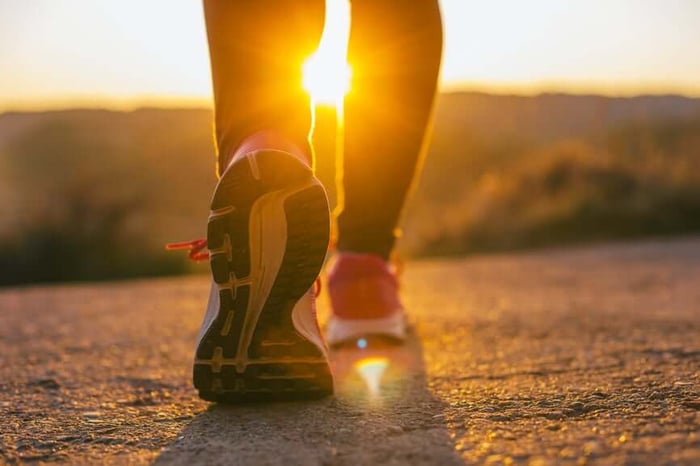
Why walking deserves a place in your daily routine
If you've been sitting at your desk wondering when you last moved from your chair, you're in good company. Recent research shows that UK adults are alarmingly sedentary, with nearly 80% failing to meet basic exercise guidelines. We spend around 9 hours a day sitting, not including sleep.
The truth is, most of us know we should move more. But knowing and doing are two different things. Over half of UK adults cite lack of motivation as their main barrier to physical activity, with gym memberships gathering dust and good intentions wilting by Wednesday.
Here's the thing: you don't need to become a marathon runner to transform your skin and health. Sometimes the simplest solutions are the most powerful.
Walking: the underrated skin treatment
Before we dive into the science (and yes, there's fascinating science), let's address the elephant in the room. Walking feels too simple to matter, doesn't it? Too ordinary to count as 'proper' exercise. Too gentle to deliver real results.
Wrong on all counts.
Recent studies demonstrate that exercise increases skin blood flow, increases keratin water content, and changes skin structure. Not bad for something you can do in your lunch break.
1. Blood flow is everything
When you walk, your heart pumps faster. This isn't just good for cardiovascular fitness. Increased blood flow during exercise improves circulation even when you're not exercising, nourishing skin cells and leading to improved cellular repair and replacement.
The increased blood flow helps flush cellular debris out of the system. Think of it as internal cleansing, but backed by actual science rather than wellness buzzwords.
That post-walk glow? It's not just endorphins. It's oxygen-rich blood delivering nutrients to your skin cells and carrying away waste products that contribute to dullness and congestion.
2. Stress shows on your face
Cortisol, the stress hormone, is skin enemy number one. It triggers inflammation, disrupts barrier function, and can send oil production into overdrive. Running reduces cortisol production, which is responsible for chronic skin conditions like eczema, psoriasis, and acne.
Exercise actually decreases the body's elevated hormonal and immune responses to stress, minimizing the risk of chronic skin condition breakouts and flare-ups.
For those managing sensitive skin conditions, this isn't just theory. Lower stress means fewer flare-ups. More stable hormones mean less reactive skin. And unlike most stress-management techniques, walking is free, accessible, and doesn't require an app subscription.
3. The anti-ageing evidence is compelling
Here's where it gets really interesting. A research study examined the skin of individuals aged 65 and older who maintained a moderate aerobic exercise routine for three months. The skin of those exercising more frequently closely resembled healthy skin for individuals of much younger ages, between 20 and 40.
Read that again. Three months of moderate exercise made 65-year-old skin look like 40-year-old skin under clinical examination.
Exercise has been shown to improve skin structure and rejuvenate its appearance, possibly through promoting mitochondrial biosynthesis. Walking can help boost collagen production and minimise the effects of free radicals that cause skin ageing.
4. Sleep quality affects everything
Just one night of sleep deprivation can make you look older, with research showing up to double the number of fine lines and wrinkles and up to three-quarters more brown spots after five nights of poor sleep.
In a 2019 study, participants who increased their daily steps by at least 2,000 showed improved sleep quality. Better sleep equals better skin repair. It's that straightforward.
5. Your skin needs oxygen
Many of us are shallow breathers, which increases stress and reduces blood circulation. Walking naturally deepens your breathing, improving oxygen delivery to all your cells, including skin cells.
Regular exercise is associated with increased blood flow to the skin, elevated skin temperature, and improved skin moisture. This isn't just about that immediate post-walk glow. It's about long-term skin health at a cellular level.
How to make walking work for your skin
The beauty of walking is its simplicity. No equipment beyond decent shoes. No membership fees. No intimidating gym environment. But there are ways to maximise the skin benefits:
Start where you are. As little as thirty minutes of aerobic activities has been proven to help people look younger. Even a 15-minute lunchtime walk beats another hour at your desk.
Protect while you walk. If you're walking outdoors, sun protection is non-negotiable. Our British Summer Time SPF 30 offers mineral protection that won't clog pores or irritate sensitive skin. Apply it 15 minutes before heading out and you're protected without the typical SPF heaviness.
Support recovery. Post-walk, your skin is primed to absorb nutrients. This is the perfect time for our Rosehip BioRegenerate Oil. The CO2-extracted rosehip delivers antioxidants exactly when your skin can use them most effectively.
Think beyond the face. Walking benefits your whole body's skin. Our Gemini Body Oil helps lock in the circulation benefits with nourishing plant oils that support skin barrier function.
The mental health bonus
In a 2018 study, just a 10-minute bout of brisk walking and meditation improved mood. Walking in nature is even better, with a 60-minute forest walk shown to decrease stress activation in the brain.
Happy brain, happy skin. It's not just a catchphrase. The gut-brain-skin axis is real, and movement positively affects all three.
Making it stick
The hardest part isn't the walking. It's the starting. And the continuing. Here's what actually works:
**Attach it to something you already do.** Walk to get your coffee. Walk during phone calls. Walk your usual bus route (or part of it).
**Make it interesting.** Podcasts, audiobooks, new routes. Boredom kills habits faster than bad weather.
**Track what matters to you.** Some people love step counts. Others prefer tracking how their skin looks and feels. Find your motivation metric.
**Start ridiculously small.** Five minutes. Around the block. To the corner shop. Success builds momentum.
The science is clear
Exercise can potentially enhance skin function retention through multiple mechanisms. Replacing sedentary time with light physical activity leads to improvements that aren't replicated by simply adding intensive exercise to a sedentary lifestyle.
In other words, that daily walk might do more for your skin than sporadic gym sessions.
The research keeps mounting. The mechanisms are being mapped. But while scientists debate the finer points of mitochondrial biosynthesis and cellular oxygenation, you could just... go for a walk.
Your skin will thank you. Your stress levels will drop. Your sleep will improve. And unlike most health advice that sounds too good to be true, this one has decades of research behind it.
The only question is: when are you starting?
For more on how exercise affects your skin, check out our post on exercise versus your skin. And if stress is your main barrier to clear skin, our guide to reducing stress might help.